
 As we look out across the San Luis Valley this late May, the snow lines are climbing higher on the Blanca Massif, and our local real estate landscape is experiencing a beautiful green-up. But the weather isn't the only thing shifting. If you’ve been keeping an eye on the local numbers, you know that our spring market has brought a tidal wave of fresh opportunities. In Alamosa alone, active inventory has scaled to roughly 165 properties—marking a stunning 71.9% increase in available homes compared to the hyper-tight baseline of last spring.
With more options on the board, properties are taking an average of 76 to 80 days to transition to pending. Because listings are staying active a bit longer, many local homeowners are looking for strategic shortcuts to simplify their sale.
Enter the most common phrase heard at local kitchen tables right now: "Can’t we just list the house ‘As-Is’ so we don't have to deal with picky buyers or sudden repair demands?"
It sounds like the perfect defensive shield. But as a certified Real Estate Negotiation Expert (RENE), I am here to tell you that in today's balanced market, the "As-Is" strategy is often a trap that drives away great buyers and leaves money on the table. Let’s pull back the curtain on how Colorado real estate contracts actually work and why transparency beats defensiveness every single time.
1. The Legal Reality: "As-Is" Doesn't Mean What You Think It Means
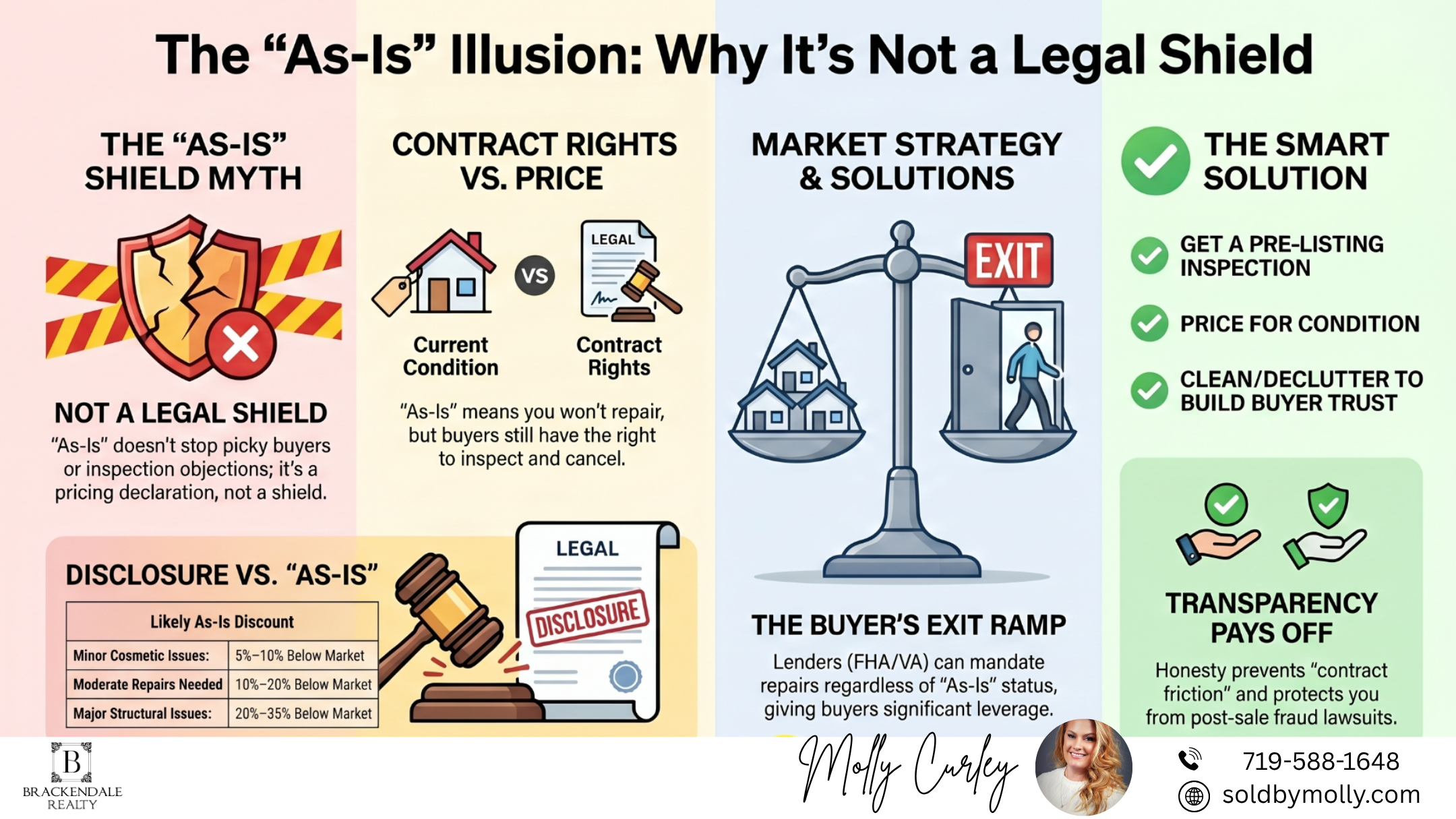
The biggest misconception about selling a home "As-Is" is that it overrides a buyer's right to negotiate or walk away.
Under the standard Colorado Real Estate Commission (CREC) Contract to Buy and Sell, the property is technically conveyed in an "As-Is" condition, but that statement is immediately followed by a crucial caveat: "except as otherwise provided in this contract".
That single phrase changes everything. The contract contains explicit, ironclad Inspection Contingencies that give the buyer the absolute right to bring in a licensed home inspector to evaluate the property from the roof to the foundation.
The Inspection Window: Even if you write "As-Is" in big bold letters on your listing, a buyer still has a negotiable window (typically 5 to 10 days) to inspect your home.
The Inspection Objection: If the inspector finds structural issues, faulty wiring, or an aging well pump, the buyer can submit a written objection demanding that you fix the issues or give them a financial credit at closing.
The Ultimate Exit Ramp: If you refuse to make the repairs, the contract allows the buyer to terminate the deal entirely before the resolution deadline and walk away with 100% of their earnest money deposit safely in hand.
The Takeaway: An "As-Is" label does not strip a buyer of their contractual protection. They can still ask for repairs, and they can still walk away if they don't like what they find.
2. Why "As-Is" Can Clear Out the Room in a Balanced Market
When inventory was incredibly tight a couple of years ago, buyers were desperate enough to overlook structural red flags. But the May 2026 market requires a completely different playbook.
With over 160 competing listings in the Alamosa area, buyers have something they haven’t enjoyed in years: the luxury of choice. When a buyer sees "Selling As-Is" attached to a residential listing today, it triggers an immediate psychological red flag. Instead of thinking, "Wow, this is a streamlined sale," they think, "What major, expensive structural failure is this seller trying to hide from me?"
Local properties are currently closing at an average of 4% to 5.7% below asking price, proving that negotiation is a vital, healthy part of the closing process right now. Leading with a rigid stance eliminates your ability to build a collaborative rapport.
To visualize how this phrase completely shifts the dynamic at the negotiation table, consider this translation:
When you think you're saying: "I just want a simple, clean transaction without minor paint or carpet negotiations."
What a savvy 2026 buyer actually hears: "There is likely serious deferred maintenance here, and the seller is going to be uncooperative during the inspection phase."
When you think you're saying: "I’ve priced the home fairly to account for its older condition."
What a savvy 2026 buyer actually hears: "The home might have systemic issues that won't qualify for traditional bank financing."
When you think you're saying: "Take it or leave it."
What a savvy 2026 buyer actually hears: "Let's click over to the other 10 homes available in this zip code that welcome a standard inspection."
3. The Golden Rule: You Can Never "As-Is" Your Way Out of Honesty
Some sellers believe that listing a property "As-Is" means they can gloss over known structural or mechanical quirks—like an underground plumbing issue or a roof that sustained damage during our recent high spring winds.
This is a dangerous legal misstep. Colorado law is uncompromising when it comes to disclosure. Sellers are legally required to disclose all known adverse material facts in writing, typically utilizing the standard Seller’s Property Disclosure (SPD) form.
What qualifies as an adverse material fact? Any structural defect, environmental hazard, mechanical failure, or legal issue that would directly impact the property's safety, utility, or financial value to a reasonable buyer.
The Legal Consequences: If you are aware of a hidden defect and fail to disclose it, the "As-Is" clause will not protect you from legal liability, structural claims, or accusations of misrepresentation long after the closing paperwork is signed.
4. The Strategic Pivot: How to Use Transparency as Leverage
Instead of trying to shield your property with defensive language, the most lucrative approach in a balanced market is to weaponize transparency. When I work with move-up sellers to position their homes against competing inventory, we swap out defensive positioning for an active negotiation strategy.
Here is how we flip the script to get you top dollar without the contract drama:
Get a Pre-Listing Inspection
Instead of waiting for the buyer’s inspector to find a surprise on day 45 of the listing, spend a few hundred dollars to get a professional home inspection done before your home goes live. This gives us a complete map of your home’s health.
Disclose and Price Accordingly
If the inspection reveals that your water heater is nearing the end of its life cycle or your roof has minor wear, we don't hide it. We list it plainly on your disclosures and price the home strategically to reflect its true condition.
Offer Pre-Emptive Credits
If a repair is needed but you don't want the hassle of managing contractors, we can state right in the listing notes: "Seller is aware the roof requires attention and has adjusted the list price accordingly, or is offering a $5,000 credit at closing toward buyer updates."
This proactive, solution-focused stance completely disarms the buyer's negotiation leverage. It builds immense trust, preserves your initial 14-day "Golden Window" of peak listing excitement, and leads to cleaner, more secure contracts that actually make it to the finish line.
Let’s Craft Your Custom Selling Strategy
Every property in the San Luis Valley—from historic homes near downtown Monte Vista to acreage properties with private wells out in the county—has a unique story and a distinct value proposition. You don't need a defensive "As-Is" label to protect your bottom line; you just need a sophisticated pricing and negotiation strategy that respects the current 2026 data.
Are you planning a move this season but worried about how your home's older systems will hold up during a buyer's inspection?
Let’s chat! I offer a complimentary "Pre-Listing Property Health Check" to help local homeowners identify which minor fixes will yield the highest return, and how to position your home to attract serious, qualified buyers.
Drop a comment below with your thoughts, or send me a direct message with the word "STRATEGY" to schedule a casual coffee consultation!